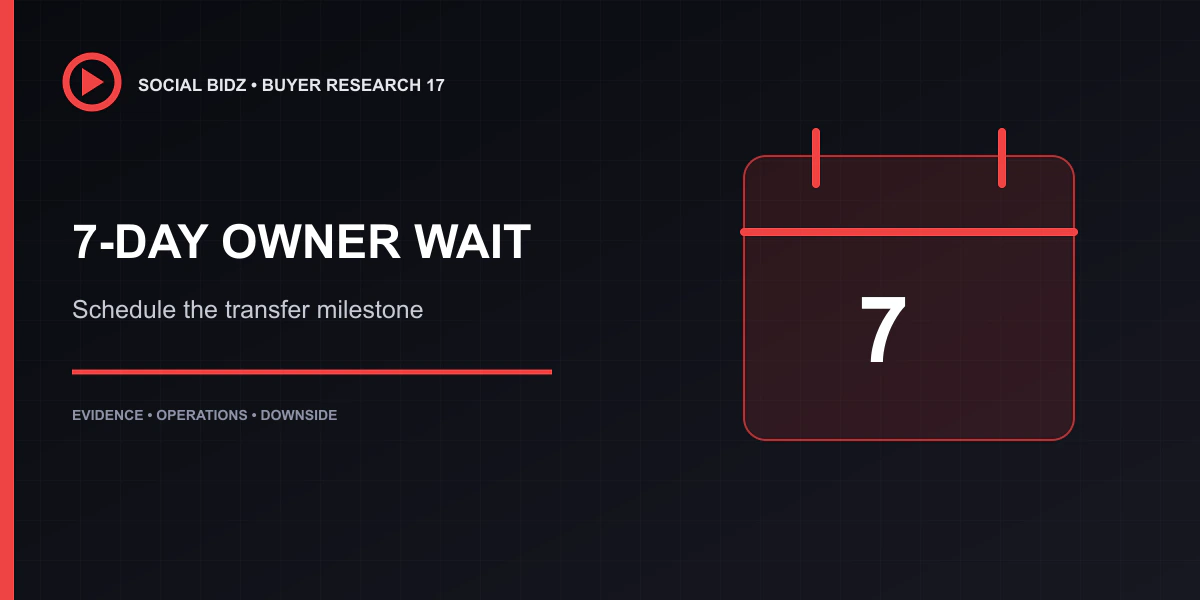
The seven-day Brand Account rule can surprise buyers who expect ownership to change immediately. It is not a reason to bypass supported controls. It is a handover dependency that should be placed on the deal timeline before money or publishing responsibilities change.
What the rule means
YouTube's official Brand Account guidance states that an owner must have held the owner role for seven days before becoming primary owner. A manager cannot change the primary owner. Confirm the current wording in YouTube's Brand Account help.
The clock concerns the ownership role, not the date the parties first spoke or the date an invitation email was sent. Confirm that the buyer accepted the correct role and record the timestamp.
Build a transfer timeline
Day zero should include verification of the Brand Account, the current primary owner, all other owners and managers, recovery arrangements, and the buyer's eligible Google account. The seller adds the buyer as an owner through the supported process.
During the waiting period, avoid irreversible rebranding or deletion. Continue due diligence, document included assets, and agree who may publish or respond to comments.
After the required period, the current primary owner can assign the buyer as primary owner. Verify the role from both sides before moving to the next deal milestone.
Diagnose common problems
If the primary-owner option is missing, check whether the buyer is an owner rather than a manager, whether seven full days have passed, and whether the channel is actually linked to the expected Brand Account. Also review whether a recent role change restarted the relevant wait.
Do not solve a missing option by sharing the seller's password. YouTube specifically recommends using Brand Account permissions to avoid password sharing.
Align escrow with controllable steps
The deal terms should define role invitation, acceptance, waiting period, primary-owner change, final verification, and removal of the seller only after agreed checks. A platform rule should not become an ambiguous “delay” that either party can interpret differently.
Use the secure transfer guide for the wider handover and the purchase agreement checklist for evidence and deadlines.
Example escrow milestones
A transaction can mark invitation sent, owner role accepted, seven-day eligibility reached, primary ownership assigned, buyer access verified, and seller access resolved as separate milestones. The payment release point depends on the marketplace terms, but the evidence for each milestone should be objective.
Do not label the deal complete merely because the buyer can open Studio. That may reflect a permission role rather than primary Brand Account ownership.
Security during the wait
Both parties should protect their own Google accounts with current recovery information and strong authentication. The buyer should not publish, remove videos, or change security settings unless the agreement authorizes it. The seller should disclose any role or policy change immediately. Keep communication inside the deal record so the timeline remains clear.
Completion checklist
Confirm the intended buyer is primary owner, review remaining owners and managers, test access using the buyer's own account, and preserve the transfer confirmation in the marketplace record. Only then continue with sensitive operational changes.
The seven-day wait is predictable when it is scheduled. The risky response is trying to remove it with credentials or unsupported shortcuts.
Seven-day wait questions
Does manager access start the owner clock? Official guidance ties primary-owner eligibility to holding an owner role. Verify the displayed role rather than assuming.
Can payment be released on invitation day? Define release according to your escrow agreement and objective transfer milestones; an invitation is not primary ownership.
What if the button is still missing? Recheck the role, accepted account, elapsed time, and Brand Account identity, then use current official support rather than password sharing.