
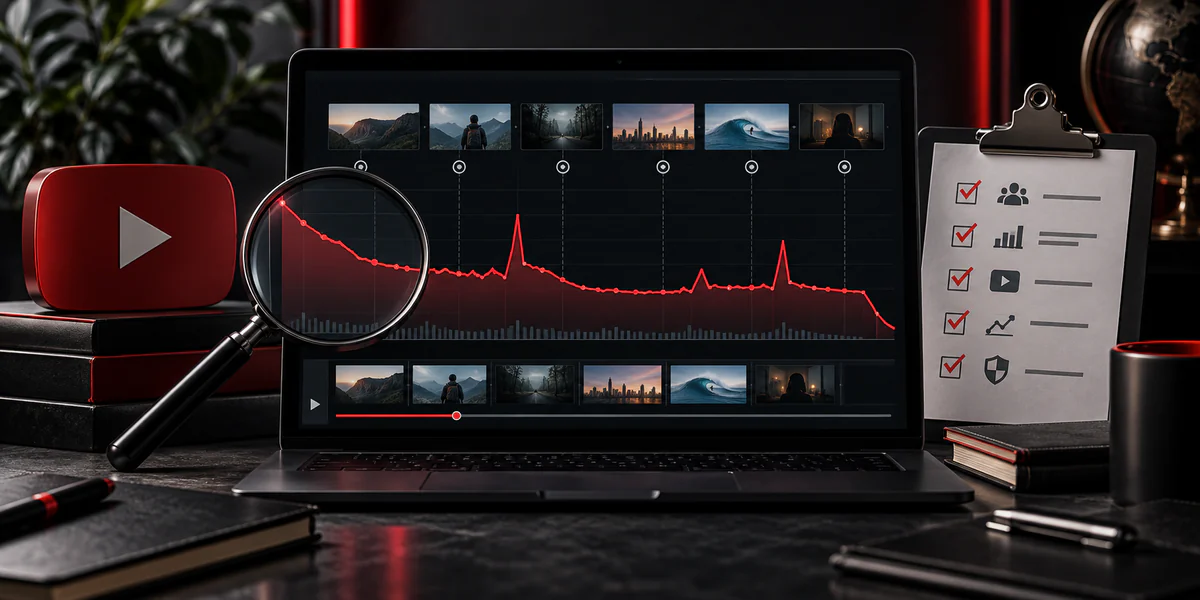
Average view duration can hide where a video wins or loses attention. A buyer should inspect retention shapes, intros, spikes, dips, and viewer segments across representative uploads before assuming that a channel's watch time will continue under new ownership.
Collect comparable retention evidence
Choose recent, high-revenue, high-view, low-performing, sponsored, and format-transition videos. Compare videos of similar length where possible. Record the first 30 seconds, average view duration, average percentage viewed, spikes, dips, and ending retention.
YouTube's key moments guide explains how to interpret flat sections, gradual declines, spikes, and dips. Retention data is video-level, so one channel average is insufficient.
Audit the opening promise
Compare the thumbnail and title with the first 30 seconds. A sharp early drop may indicate that packaging overpromises, the introduction delays the answer, or returning viewers skip a repeated opening.
Review several publication periods. One failed intro is a creative lesson; a repeated mismatch is a process risk the buyer will inherit.
Investigate spikes
Spikes can reflect rewatching, sharing, a chapter jump, or viewers scrubbing to a specific answer. Identify what happens at each major spike and whether it represents value or confusion.
For tutorial channels, a concentrated answer may support search value. For narrative channels, a spike around the ending can indicate viewers skipping most of the story. Context determines the acquisition meaning.
Investigate dips
Mark sponsorships, tangents, pacing changes, repetitive segments, factual corrections, and calls to action near dips. Compare performance when the same segment appears across multiple videos.
If sponsor reads consistently lose viewers, sponsorship revenue must be evaluated together with its audience cost. Use the sponsorship revenue guide for the contract side.
Segment the audience
Where available, compare new versus returning viewers, subscribers versus non-subscribers, and organic versus paid traffic. A blended curve can hide weak organic attention behind paid placements or a loyal core behind broad low-intent discovery.
The paid promotion audit explains how to isolate campaign-driven viewing.
Compare production eras
Group videos by host, editor, series, length, thumbnail style, and production vendor. Use Advanced Mode comparisons when available. This reveals whether retention improved because of a transferable system or because one individual changed the work.
Request style guides, edit notes, and source files for the strongest era. A buyer cannot pay for a pattern that cannot be reproduced.
Link retention to economics
Compare retention with watch time, revenue, subscriber gains, sponsor conversions, production cost, and update requirements. High retention on expensive videos can produce lower profit than moderate retention on a durable catalog.
Use the channel profit guide to keep creative quality connected to operating cost.
Run a buyer-operated test
Before the final handover where practical, produce or prepare one representative video with transferred staff and assets. If publication is not appropriate during escrow, complete an internal edit review using the seller's standards and compare it with a finished reference.
Record which creative decisions required undocumented seller judgment.
Buyer decision rule
Value retention when the pattern is broad, explainable, audience-appropriate, and reproducible. Discount a channel where strong averages depend on one short format, one host, paid traffic, or a few exceptional videos.
Retention questions
What is a good retention percentage? There is no single target for every length and format. Compare similar videos, historical baselines, and the economics of the specific channel.
Do spikes always indicate success? No. They can show replay value or viewers skipping to an answer. Inspect the content at that moment.
Can retention predict post-sale results? It provides evidence about viewer behavior, but a new owner can change packaging, host, topic, and production quality. Include a transition downside.
How this guide is prepared
Social Bidz guides separate seller-supplied claims from evidence a buyer can check. Platform-policy statements should use public platform documentation, while prices and revenue are treated as variable marketplace data rather than promised results.