
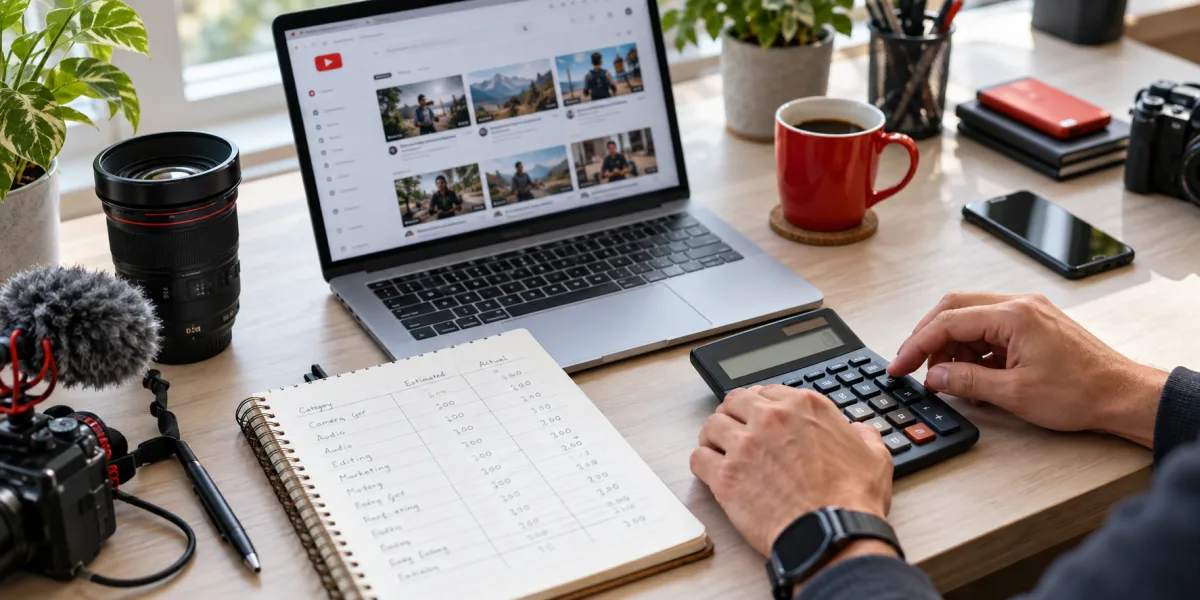
An asking price is the cost of acquiring the channel on the agreed terms. It is not the amount of cash you need to operate it after the seller leaves. Buyers who spend their entire budget at checkout can discover that the next upload requires an editor, a licence or several days of work they have not planned for.
A takeover budget answers a different question from a valuation: can you fund the purchase and continue the content model without relying on immediate future earnings? Start with the available cash, then allocate it to the transaction, the first production period and a reserve for problems you can identify.
Build four separate budget lines
| Budget line | Include | Evidence to use |
|---|---|---|
| Acquisition | Agreed channel price and named included assets | Accepted deal and asset list |
| Checkout | Displayed service fee and applicable payment charges | Final payment screen and provider quote |
| First production period | Editing, footage, tools, host time and contractor costs | A realistic upload schedule and written supplier prices |
| Transition reserve | Replacement files, delayed uploads or other identified gaps | Questions unresolved in the handover plan |
Keep these lines separate even when one supplier provides several items. Doing so lets you change the price or publishing schedule without losing track of why the total moved. A seller's historic monthly revenue belongs in your operating forecast, not in the cash available to complete the purchase today.
An illustrative takeover budget
Suppose a buyer has $1,200 in available cash and agrees to a $600 channel price. For this example only, assume the displayed checkout fee is $30. That leaves $570 after the purchase and fee; it does not mean the buyer can comfortably spend all $570 on equipment.
| Item | Illustrative amount |
|---|---|
| Agreed channel price | $600 |
| Checkout service fee shown for this example | $30 |
| Four edited videos at $40 each | $160 |
| Tools and transferable media licences | $50 |
| Transition reserve | $150 |
| Total planned spending | $990 |
| Cash remaining from the $1,200 budget | $210 |
These figures are invented to demonstrate the arithmetic. They are not SocialBidz pricing, contractor quotes or expected returns. Replace every row with a current quote for your chosen channel. The useful result is that the $600 asking price consumes half the cash, while the complete plan consumes $990.
Live marketplace
Apply your budget to current asking prices
The prices below are listing prices. The final checkout fee and your operating budget are separate. These examples are not selected for affordability.
465 active listings currently available.



Use the actual checkout fee
SocialBidz's current public explanation describes a 1.5-7% buyer service fee with a $2 minimum. The escrow page provides context, but the accepted deal's displayed charge is the amount to use in your budget. Plan benefits, discounts and the configured fee rules can affect a particular transaction.
Do not substitute the lowest percentage in a published range for a quote. On a small purchase, a minimum charge can matter more than a percentage. If a payment method has a separate charge or currency conversion, record that cost in its own row. It should not be disguised as part of the seller's asking price.
Cost the first uploads before you make an offer
Take one ordinary video from the channel's recent archive. List the steps needed to produce the next video of that type: research, script, recording, editing, thumbnail, checking rights and publishing. Ask who performs each step now and whether that person or arrangement continues after the sale.
Count your own work too. It may not require an immediate cash payment, but a schedule built around twenty free hours that you do not have is not sustainable. If the channel relies on the seller's specialist skill or on-camera presence, find the replacement cost before accepting the price.
The existing profit guide helps reconcile historical operating costs. Here, the objective is narrower: estimate the money and time your first production cycle requires. An included editing workflow is useful only if you can actually use it.
Choose a reserve for a named problem
A reserve should correspond to plausible gaps rather than a magical percentage. You might need to commission a replacement thumbnail set, buy a licence that cannot transfer or allow for a missed upload during the handover. Record the reason and the proposed amount beside each reserve item.
Avoid counting the same cost twice. If replacing a contractor is already included in the production budget, reserve only for the extra disruption you expect. Equally, a reserve is not a remedy for missing ownership evidence. Resolve an untransferable or unidentified asset before paying, rather than assigning it a contingency allowance.
Calculate the asking price you can afford
Work backwards when cash is limited. Subtract the required content runway, fixed transition costs and reserve from the cash you can commit. The remaining amount must cover both the acquisition price and checkout. Try several candidate asking prices using the fee actually displayed for each proposed deal.
This is an affordability calculation, not a claim about market value. A channel can be fairly priced yet unsuitable for your available budget. The valuation guide covers the separate question of what the asset's evidence supports.
Recheck before funding
Review the final asset list, current payment charge and first-month production plan together. Have any included files disappeared from the deal? Has the contractor changed the quote? Does a payment provider require a different currency? Update the budget before making the commitment.
If the plan still fits, you can proceed with a clearer understanding of what you are buying and what you must fund next. If it does not, reduce the acquisition budget or choose a simpler operating model. A lower asking price is useful only when the resulting channel remains practical to run.